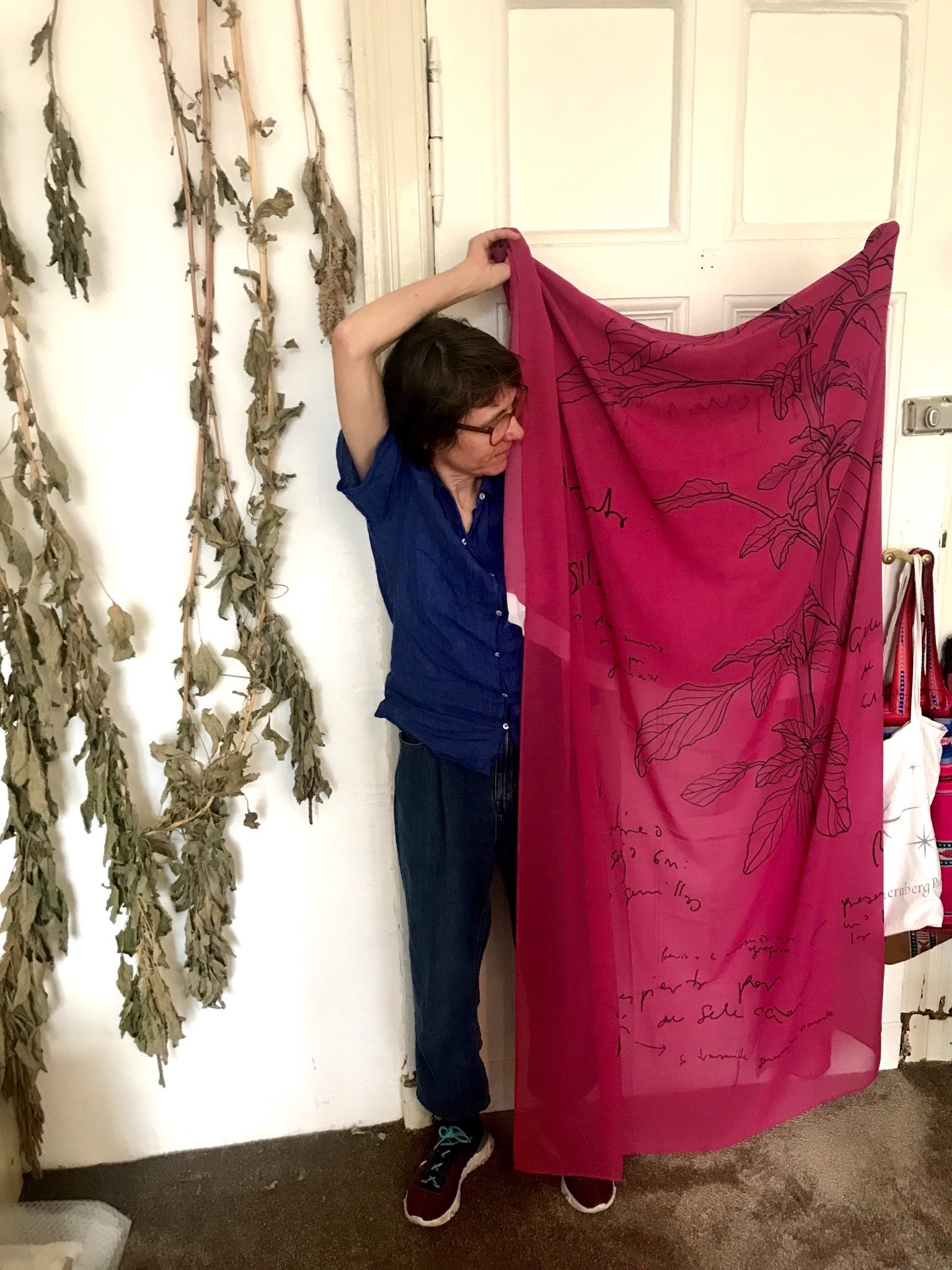
Julia Mensch studierte in der Klasse von Hito Steyerl an der Universität der Künste Berlin sowie an der Nationalen Kunstuniversität in Buenos Aires. Derzeit ist sie Doktorandin an der Bauhaus-Universität Weimar und Forscherin im SNSF-Forschungsprojekt «Plants_Intelligence». Learning Like a Plant wurde von Yvonne Volkart, Felipe Castelblanco, Julia Mensch und Rasa Smite am Institut Art Gender Nature der Hochschule für Gestaltung und Kunst Basel FHNW realisiert.
Julia Mensch entwickelt ihre Praxis auf der Grundlage von Langzeitforschung, Lektüre von Belletristik und Theorie, Interviews und Besuchen in Archiven und Gebieten. Ihre Arbeit verbindet Text, Zeichnung, Installation, öffentliche Veranstaltungen, Fotografie, Video und Vortragsperformance miteinander, um kollektive Dialoge über politische und soziale Kontexte und Zukunftsszenarien zu eröffnen. Der Fokus ihrer Arbeit liegt auf der Geschichte des Sozialismus und Kommunismus sowie auf umweltbezogenen soziopolitischen Konflikten in Lateinamerika. Dabei setzt sie sich mit den ausbeuterischen Bedingungen des Landes und der Menschen seit der Kolonialisierung und während des Neokolonialismus auseinander. In den letzten Jahren hat sich Julias künstlerische Arbeit auf das neoextraktivistische Modell der transgenen Landwirtschaft in Argentinien konzentriert. Hierzu arbeitet sie mit Wildpflanzen sowie mit Landwirten, Agrarökologen, Umweltaktivisten und kritischen Wissenschaftlern zusammen.
/
Julia Mensch studied at the Hito Steyer’s class at the UdK, Berlin, and at the National Art University in Buenos Aires. Currently, she is a PhD Candidate at Bauhaus University, Weimar, and a researcher of the SNSF-research project ‚Plants_Intelligence. Learning Like a Plant‘, realized by Yvonne Volkart, Felipe Castelblanco, Julia Mensch, and Rasa Smite at the Institute Art Gender Nature, Basel Academy of Art and Design FHNW.
Julia develops her practice based on long-term research, readings of fiction and theory, interviews, and visits to archives and territories. Her work is an intersection of text, drawing, installation, public events, photography, video, and lecture performance to open collective dialogues regarding political and social contexts and future scenarios. Her practice focuses on the history of Socialism and Communism as well as environmental socio-political conflicts in Latin America, confronting the exploitative conditions of the land and beings since colonization and throughout neocolonialism. In recent years, Julia’s artistic work has focused on the neo-extractivist model of transgenic agriculture in Argentina by cooperating with wild plants and farmers, agro-ecologists, environmental activists, and critical scientists, who are creating resistance and alternatives to this ecocide model.
«Kiwicha» (Sunday, September 14, 2025 / 2 p.m.)
Lecture performance and open discussion (online/eng)
Part of the ongoing project «Amaranth as Political Agent». Within the framework of the research project «Plants_ Intelligence. Learning Like a Plant» (2022 – 2025). A research project by Yvonne Volkart, Felipe Castelblanco, Julia Mensch and Rasa Smite. Funded by the Swiss National Science Foundation and hosted by the Institute Art Gender Nature, Basel Academy
of Art and Design FHNW.
In the context of Argentina’s implementation of transgenic agriculture since 1996, Amaranth was the first wild plant to develop resistance to agrochemicals, growing in GM fields. Named Kiwicha, Yuyo Colorado, or Amaranthus, it is a plant native to the Americas: its seeds were preserved by indigenous peoples, despite the Spanish colonizers’ prohibition, and today it is the most widespread glyphosate-resistant weed. Currently, it covers over 25 million hectares. Perhaps it is, as the scientist and environmental activist Andrés Carrasco called it, the revenge of the Americas.
I explore the condition of Amaranth as a political agent whose growth intervenes, naturally and politically, in the nucleus of transgenic agriculture’s neocolonial and ecocidal model. I trace nature’s wisdom and the cooperation and reciprocity between Amaranth and other spontaneous vegetation as forms of intelligence. Therefore, I aim to learn from agroecology and indigenous knowledge and explore how we might collaborate and conspire[1] politically with plants. I investigate how art practices can contribute to the construction of Buen Vivir.[2]¨
plants-intelligence.ch
juliamensch.com
instagram @julia_mensch_
[1] Myers, Natasha, “The world to come : art in the age of the Anthropocene,” Samuel P. Harn Museum of Art, University of Florida, 2018, p. 55
[2] Good Living: concept in collective construction. Old-new paradigm, based on the indigenous concept of Sumac Kawsay. Eduardo Gudynas and Alberto Acosta explain that Buen Vivir looks to Indigenous knowledge to seek alternatives to Western development. Unlike the neo-extractivist model, it recognizes the rights of nature.
 WHAT'S COOKING? A RE-ARRANGEMENT | EINE UM-ORDNUNG